

Published: 2026-07-21 | Author: Karl Huang
Deciding the Best Time for 10-Day Xinjiang Itinerary trips is the one choice that makes or breaks the whole route. I learned this the hard way in late May 2022, when I landed in Urumqi with a group of six and found the Duku Highway still chained shut. We had budgeted three days for the mountain crossing and lost them to a rerouted desert drive. Since then I have run the loop in every season, and the window I keep coming back to is the last three weeks of September.
In this guide I walk through what each season actually delivers on the ground, give you a 10-day route that works in that window, and lay out the real costs from my most recent September trip: 4,800 RMB per person all-in, excluding international flights. If you are building a 10-Day Xinjiang Itinerary, the timing section below is the part to read twice.
Quick Reference
| Stop | Entry fee (RMB) | Best time | Elevation / role |
|---|---|---|---|
| Urumqi (start/end) | Free old town; 30 museum | Year-round hub | 800 m, transport hub |
| Turpan (Flaming Mountains) | 40 Flaming Mts; 70 Jiaohe | Apr–May, Sep–Oct | −50 m, lowest basin |
| Korla / Bosten Lake | 45 Bosten | Jun–Sep | 930 m, gateway south |
| Kuqa (Grand Canyon) | 40 Kizil; 35 canyon | May–Oct | 1,100 m, Silk Road town |
| Bayinbuluke Grassland | 65 + 90 shuttle | Late Jun–Sep | 2,500 m, alpine meadow |
| Nalati Grassland | 95 + 60 shuttle | Jun–Sep | 1,800 m, valley pasture |
| Yining / Sayram Lake | 70 Sayram + 75 shuttle | Jun–Sep | 2,070 m, alpine lake |
My 10-Day Loop, Season by Season
I will describe the standard counter-clockwise loop that most of my groups use, then explain how it shifts with the calendar. We started in Urumqi on a Tuesday, picked up a 7-seat van from a rental desk near Hongshan Square for 600 RMB a day, and drove out before the morning traffic cleared. The first real stop was Turpan, two and a half hours south on the G30. By noon we stood at the Flaming Mountains viewing platform where the thermometer read 43°C in the shade, because there was no shade.
From Turpan we pushed to Korla on day three, stopping at Bosten Lake for a short walk along the reed boardwalk. The lake was calm and the light flat, good for photos but nothing dramatic. Kuqa came next, and the real highlight was the Kizil Caves, the oldest Buddhist cave complex in Xinjiang. Our guide Akbar, who has worked there nineteen years, pointed out the blue demon figures unique to this site.
The spine of the trip is the Duku Highway, which we crossed on day five from Kuqa up to Bayinbuluke. That stretch alone saved us nine hours versus the old desert detour, and it is only open roughly June 1 to September 30. Missing that window means the entire northern half of the loop is gone. We spent the night at Bayinbuluke at 2,500 meters; a few people in the group felt the altitude and slept lightly.
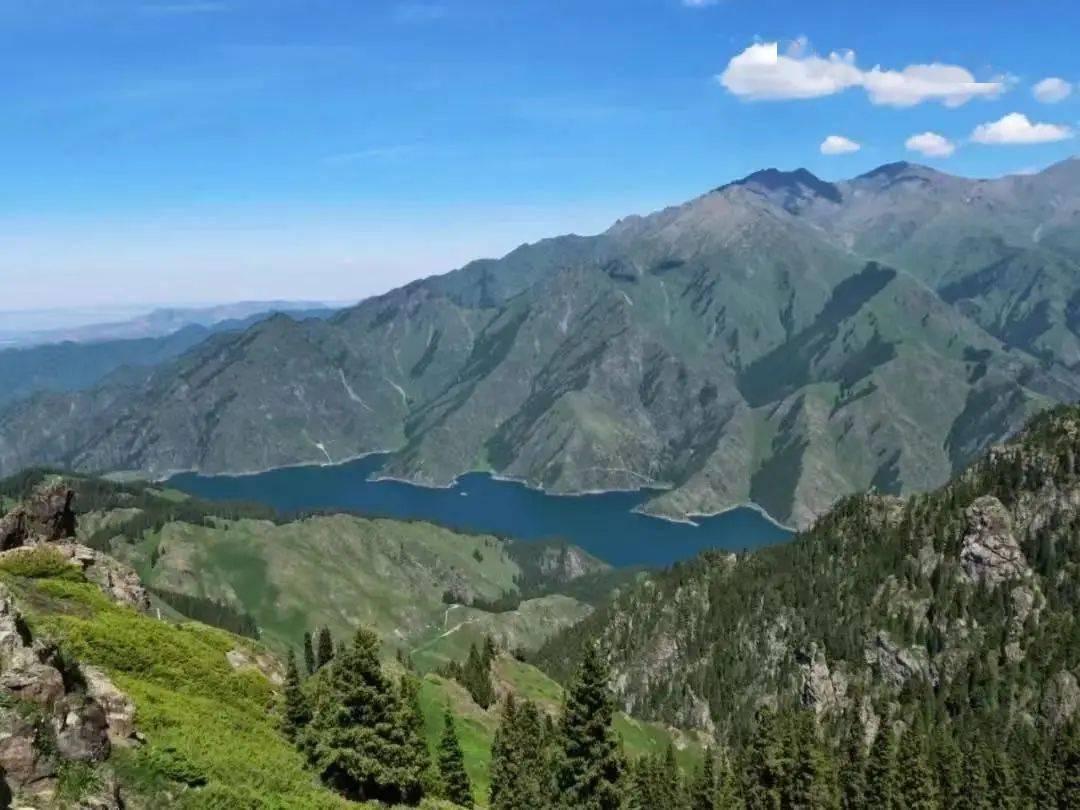
Days six through nine took us across Nalati, down to Yining, and up to Sayram Lake. At Sayram in late September the water turned steel blue and the surrounding hills carried the first yellow of the season. We ended back in Urumqi on day ten with about 2,100 km on the odometer.
How to Get There
Most travelers fly into Urumqi Diwopu International Airport (URC). Direct flights run from Beijing (about 4 hours, 1,800–2,400 RMB one way depending on season), Shanghai (5.5 hours, 2,200–3,000 RMB), and Guangzhou (5 hours, 2,000–2,800 RMB). If you are coming from abroad, book the international leg to a major Chinese hub and connect onward. A Xinjiang Self-Driving Guide is worth reading before you commit to a rental, because road rules and checkpoint procedures differ from the east.
Within the region, the train is comfortable for the long hauls. The Urumqi–Korla bullet train takes about 3 hours and costs 130 RMB in second class. For the loop above, though, a car is necessary once you leave the main rail lines. We rented through a local agency rather than a national chain and saved roughly 150 RMB a day.
Domestic flights also link Urumqi to Kashgar, Yining, and Altay if you want to shorten the drive. I priced a Urumqi–Yining flight at 520 RMB in September, versus a 9-hour drive. For a 10-day plan, flying one leg and driving the rest is a reasonable compromise.
Best Time to Visit: the Best Time for 10-Day Xinjiang Itinerary
Spring (April to mid-May) is unstable. The grasslands are still brown, mountain passes can close without notice, and sandstorms hit the south. I once postponed a Turpan leg by two days because of a dust storm that dropped visibility to 200 meters. Avoid this window unless you specifically want empty sites and the lowest prices.
Summer (June to August) is the reliable season. The Duku Highway is open, the grasslands are green, and the weather is warm. The downside is crowds and cost: hotel rates in Bayinbuluke roughly double in July, and the shuttle buses at Nalati ran every twenty minutes to handle the load. If your only window is summer, go in early June before the school holidays start. This is the season most first-timers pick, but it is not the Best Time for 10-Day Xinjiang Itinerary if you would rather skip the crowds.
Autumn (mid-September to mid-October) is the window I recommend. The poplar forests along the Tarim turn gold around October 10, Sayram Lake is clear, and the highway is still open through September. On my last September trip the temperature ranged from 8°C at night in Bayinbuluke to 24°C in Turpan. Crowds thin out after the National Day holiday ends on October 7. In my experience this is the Best Time for 10-Day Xinjiang Itinerary travel: the roads are open, the autumn light is clear, and you avoid the summer price spikes.
Winter (November to March) is harsh. Many grassland sites close, the Duku Highway shuts, and daytime highs in Urumqi sit near −10°C. The appeal is snow scenery and rock-bottom hotel rates, but a 10-day loop is not practical when half the route is closed. Save winter for a single-city trip or a ski week at the Silk Road resort.
Where to Stay
Budget: In Urumqi and the bigger towns, clean business hotels run 180–260 RMB a night. We used a chain near the south gate in Urumqi for 220 RMB and it was fine. In smaller stops like Kuqa, guesthouses start at 150 RMB.
Mid-range: Expect 350–550 RMB for a solid four-star with breakfast. The Silk Road hotel in Korla charged us 420 RMB and had reliable heating, which matters at altitude. Bayinbuluke has limited stock, so book the 480 RMB options early in September.
Upper: Urumqi has two international brands at 700–1,100 RMB. On the route itself, the best upper option is the lakeside lodge at Sayram, around 900 RMB in shoulder season. Worth it for one night if the budget allows, because you can photograph the lake at dawn before the tour buses arrive.
Food
Xinjiang food is the part travelers remember longest. In Urumqi, a full da pan ji (big plate chicken) for three people cost 88 RMB at a family spot on Minjie Street. Hand-pulled laghman noodles ran 22–30 RMB. In Turpan we ate grilled mutton skewers at 3 RMB each and bought seedless grapes at 6 RMB a kilo straight from the vineyard.
Kuqa is known for its ququ (tiny mutton dumplings in soup), about 25 RMB a bowl. At Sayram Lake the lakeside restaurants mark up everything; a simple noodle soup was 38 RMB. I advise buying fruit, bread, and water at the morning markets in Yining and packing a day bag, which saved the group roughly 120 RMB a day versus eating every meal at tourist stops.
Tea houses in the old towns serve kawap and flatbread for pocket change. The single best meal of the trip was a 60 RMB lamb leg shared among four of us in a courtyard in Kuqa, eaten with our hands at a low table.
Practical Tips
- Book the Duku Highway crossing for a day with a clear forecast; weather at the summit changes fast and the road closes on short notice.
- Carry both digital and paper ID. Checkpoints between prefectures are routine and you will show documents several times a day.
- Pack for two climates. A 2,500 m night in Bayinbuluke can hit 5°C while Turpan the same afternoon is 35°C.
- Download offline maps. Signal drops for long stretches on the Duku and around Sayram.
- Reserve Bayinbuluke and Sayram lodging at least three weeks ahead in September; both sell out.
- Foreign visitors should check the latest entry rules before flying; a Xinjiang Visa and Permit Guide covers the documents I see most often forgotten.
Sample Itinerary
Day 1: Arrive Urumqi, rest, visit the Regional Museum (30 RMB).
Day 2: Drive to Turpan: Flaming Mountains (40 RMB), Jiaohe Ruins (70 RMB).
Day 3: Turpan to Korla via Bosten Lake (45 RMB), overnight Korla.
Day 4: Korla to Kuqa: Kizil Caves (40 RMB), Kuqa Grand Canyon (35 RMB).
Day 5: Kuqa to Bayinbuluke across the Duku Highway (65 RMB + 90 shuttle).
Day 6: Bayinbuluke to Nalati Grassland (95 RMB + 60 shuttle).
Day 7: Nalati to Yining, afternoon at the Ili valley market.
Day 8: Yining to Sayram Lake (70 RMB + 75 shuttle), overnight lakeside.
Day 9: Sayram to Urumqi via Bole and the G30, about 9 hours.
Day 10: Urumqi free morning, fly out.
For travelers watching costs, a Xinjiang Budget Travel Guide pairs well with this route; I used its train-and-hostel tips to trim the September trip to 4,800 RMB per person.
FAQ
Is September really better than July for a 10-day trip?
For road trips, yes. July has greener pastures but heavier crowds and higher hotel rates. September keeps the Duku open, cools the deserts, and clears the sites after National Day.
Can I do this loop in a rental car without a guide?
Yes, if you are comfortable with long drives and checkpoints. The self-driving guide above covers the paperwork. I still recommend a local guide at Kizil Caves for the history.
What if it rains during the Duku crossing?
Light rain is fine. Heavy rain or snow closes the summit temporarily. Build one buffer day into the 10-day plan so a closure does not cascade.
How much should I budget beyond the 4,800 RMB?
That figure covers lodging, fuel split across the group, entry fees, and most meals. Add international flights, souvenirs, and a safety margin of 500–800 RMB.
Do I need a special permit for the areas on this route?
The main loop does not require border permits. The visa and permit guide lists the few areas near the Pamirs that do, which this route avoids.
Is the altitude a problem?
Bayinbuluke at 2,500 m is the highest overnight stop. Most people are fine with a slow first evening. If you have heart or lung conditions, talk to a doctor first.
Disclaimer
Entry fees, hotel rates, fuel prices, and road-opening dates in this article reflect what I paid or observed on specific trips through 2023–2025 and change without notice. The Duku Highway opening each year depends on snow clearance and is announced by local transport authorities. Visa, permit, and checkpoint rules also change. Always confirm current prices and requirements with official sources and your embassy before you travel. This guide shares first-hand experience and is not a substitute for official advice.