

Published: 2026-07-26 | Author: Karl Huang
The Xinjiang Autumn Kanas Guide on this page comes from six trips I made to the Kanas region between 2018 and 2024. My favorite run was in early October 2022, when I rode the 7:40 morning shuttle from Jiadengyu (贾登峪) up to the lake with a local guide named Aibek, paid 230 RMB for the combined Kanas-Hemu ticket, and watched the larch turn gold before 9 a.m. I wrote these notes down so you can time the color, control the budget, and skip the worst of the crowds on your own autumn trip.
Quick Reference
| Detail | Information |
|---|---|
| Location | Kanas Lake, Altay Prefecture, northern Xinjiang (about 48.7°N, near the Kazakhstan and Mongolia borders) |
| Entry fee | 230 RMB combined Kanas + Hemu + Baihaba ticket in peak season, plus 100 RMB for the shuttle bus; off-peak drops to around 105 RMB plus 60 RMB shuttle |
| Best time | Late September through the first week of October, with the strongest larch color usually from Sept 28 to Oct 8 |
| Elevation / role | Lake surface sits at 1,374 m; the surrounding peaks run 2,000 to 3,000 m and form the windbreak that traps the cold air responsible for early frost |
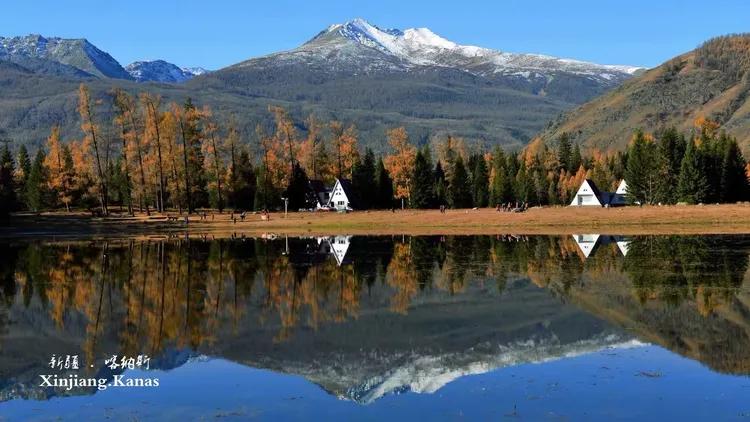
My First Autumn in Kanas, in the Flesh
I first reached Kanas in 2018 on a cold, clear morning at the end of September. The previous night I had slept in a wooden cabin in Hemu Village, where the heater rattled and the tap water came out near frozen. At 6:30 a.m. I walked out and the whole valley was still. Then the light hit the birch and the larch, and the hills went from green to yellow to orange in about twenty minutes.
What surprised me most was the scale. Kanas Lake is 24 km long, and from the wooden viewing platform at Guanyu Pavilion you look straight down a channel of water that changes color with the cloud cover. On a bright day it is a deep green; on an overcast morning it turns steel blue. I spent two hours there with only a handful of other visitors because most tour buses arrive after 11 a.m.
The second trip taught me about cost. In 2019 I booked through a Urumqi agency that bundled the flight, the shuttle, and three nights into one price of 3,800 RMB. It was convenient but rigid. By 2022 I was booking the pieces myself: a one-way flight to Kanas Airport for 1,450 RMB, a shared van from the airport to Jiadengyu for 50 RMB, and guesthouses I could change on the fly. That flexibility saved me money and let me chase the weather.
If you want the full background on the lake itself, the Kanas Lake Travel Guide I wrote covers the legends, the fish, and the walking routes in more depth than I can fit here.
How to Get There
Most travelers start from Urumqi. You have three realistic options.
The fastest is to fly. Urumqi Diwopu Airport (URC) runs seasonal flights to Kanas Airport (KJI) from June to early October. The flight takes about 1 hour 40 minutes. I paid 1,450 RMB one way in 2022 and 1,180 RMB in 2024 when I booked three weeks ahead. From Kanas Airport a shared van reaches Jiadengyu, the gateway town, in roughly 90 minutes for 50 RMB per seat.
The second option is the train plus bus. Take the overnight train from Urumqi to Beitun (北屯), about 11 hours, with a hard sleeper around 260 RMB. From Beitun station a bus or hired car covers the remaining 250 km to Jiadengyu in 4 to 5 hours. The bus costs about 80 RMB; a private car for four people runs 700 to 900 RMB.
The third route suits self-drivers. The road from Urumqi to Burqin is about 650 km and takes 8 to 9 hours with a stop. From Burqin it is another 130 km to Jiadengyu. I drove this in 2021 and the section past Colorful Beach along the Irtysh River was worth the long day, but only attempt it if you are comfortable with mountain driving in cold weather.
Once inside the scenic area you cannot use private cars. Everyone transfers to the managed shuttle system, which is included in your ticket. Buses run from Jiadengyu to the lake, to Hemu, and to Baihaba on a fixed schedule.
Best Time to Visit: When the Xinjiang Autumn Kanas Guide Says Go
Autumn is short and sharp in Altay, so timing matters more than anywhere else I have traveled in Xinjiang.
Early September still feels like late summer. The grass is green, the trees are mostly green, and the crowds are light. If you hate cold, this is pleasant, but you will miss the color.
Mid to late September is the shoulder. The birch starts to yellow from the higher ground down. By Sept 25 the larch usually begins its turn. Daytime temperatures sit around 10 to 16°C, and nights drop near freezing. This is my preferred window because prices have not peaked and the light is clean.
The first week of October is peak. This is when the Xinjiang Autumn Kanas Guide says the hills look their best, with full gold larches against snow-dusted peaks. It is also when the area is busiest and the wind cuts hard. Expect frost every morning and occasional early snow above 2,000 m.
After October 10 most lodges in Hemu close, and the shuttle to Baihaba may stop if snow blocks the pass. By mid October the season is effectively over until the ski roads open.
For the day-by-day weather and color outlook, the Best Time to Visit Kanas Lake page tracks the same data with a month-by-month breakdown.
Where to Stay
You have three base towns, and your choice changes the whole rhythm of the trip.
Budget travelers should look at Hemu Village. Wooden cabins there start around 180 to 280 RMB per night in shoulder season and climb to 500 RMB or more during the October peak. The cabins are basic: thin walls, a shared bathroom block, and no reliable heating in some. What you get in return is the morning mist over the river and a short walk to the famous Hemu viewpoint.
Mid-range visitors do best in Jiadengyu. The gateway town has standard hotels from 350 to 600 RMB, with proper heating and private baths. You lose the in-village atmosphere but gain a reliable hot shower and an easy shuttle connection.
Upper-budget travelers can book the lakeside lodges inside the scenic area, which run 900 to 1,500 RMB per night in autumn. They are the only rooms within walking distance of the water at sunrise, and that alone justifies the price for serious photographers.
Food
Altay cooking leans Mongolian and Kazak. The signature dish is the grassland hot pot, a mild broth loaded with lamb, potato, and cabbage, enough for two at about 120 to 160 RMB. I ate it four times in 2022 and never grew tired of it.
Hand-grabbed lamb (手抓肉) costs around 88 RMB per portion and comes with flatbread. Milk tea (奶茶) is the everyday drink, salty rather than sweet, at 10 to 15 RMB a bowl. In Hemu I found fresh river trout grilled over coals for 60 RMB, and a plate of fried wild mushrooms for 45 RMB during the short autumn harvest.
Prices rise inside the scenic area. A simple noodle soup that costs 25 RMB in Burqin can run 40 RMB at the lake canteen. Carry some snacks and water from Burqin or Urumqi to soften the markup.
Practical Tips
- Book your Kanas flight at least three weeks early. Seats in early October sell out, and walk-up fares double.
- Pack for two seasons. Bring a down jacket and gloves for the mornings, but keep a t-shirt for the midday sun. Layers beat one heavy coat.
- Carry cash in small bills. Some Hemu cabins and the village horse-cart drivers do not take mobile payment reliably.
- Start every viewpoint before 8 a.m. The tour buses arrive after 10:30, and the mist lifts by 9, so the quiet window is short.
- Watch the altitude and the cold together. At 1,374 m you will not feel sick, but a cold wind at that elevation drains energy fast. Drink water and eat on schedule.
Autumn light in Kanas is the reason many visitors come, so the Xinjiang Photography Guide I maintain has a full section on the best hours and the lens choices that handle the contrast between snow and gold leaves.
Sample Itinerary
This five-day plan is the one I recommend to first-timers who want the color without the rush.
Day 1: Fly Urumqi to Kanas Airport, transfer to Jiadengyu, check in, and eat a quiet hot pot dinner. Rest early.
Day 2: Morning shuttle to Kanas Lake. Walk the boardwalk to Guanyu Pavilion, then take the boat across to the quieter eastern shore. Return to Jiadengyu for the night.
Day 3: Transfer to Hemu Village. Hike to the Hemu viewpoint for sunset, then stay in a cabin. Wake at 6:30 the next morning for the mist.
Day 4: Morning in Hemu, then a guided trip to Baihaba Village near the border for Kazakh homestay lunch. Back to Jiadengyu.
Day 5: Shuttle out to Burqin, see Colorful Beach in the late light, and take the evening bus or train toward Urumqi. The Hemu Village Travel Guide has the cabin booking details and the viewpoint trail map if you want to extend a day.
FAQ
Is late September too early for the color? Not at all. By Sept 25 the birch is yellow and the larch is starting. You trade a little peak intensity for far smaller crowds and lower prices.
Do I need a border permit for Kanas? The main lake and Hemu do not require a special permit for foreign visitors, but Baihaba sits in a border zone and needs the permit arranged through your hotel or the scenic-area office. The Xinjiang Visa and Permit Guide covers the paperwork.
Can I see Kanas in one day? You can touch the lake in a day if you fly in and out, but you will miss Hemu and the morning mist, which is the real draw. Plan at least three full days.
How cold does it get at night? In early October Hemu cabins dropped to minus 3°C on the two nights I stayed in 2022. Bring a real sleeping layer even if your room has a heater.
Is the area worth it if I only have a week in Xinjiang? Yes, if autumn color is your goal. The Xinjiang Autumn Kanas Xinjiang route pairs well with a Urumqi stop and gives you the strongest landscape payoff per day of any region I cover.
Disclaimer
Prices, permits, flight schedules, and shuttle routes change from season to season and were accurate to the best of my knowledge for the 2018 to 2024 travel years. Border rules in Altay can shift with little notice. Always confirm the current ticket price, the Baihaba permit process, and flight availability with the official Kanas scenic-area office or a licensed Xinjiang travel agent before you commit money. This Xinjiang Autumn Kanas guide shares personal experience, not a guarantee of conditions on any given date.