

Published: 2026-07-31 | Author: Karl Huang
The first time I drove out to Tuergen I got the timing wrong by nine days. That was April 2019. I arrived on the 22nd, walked up the ridge behind the shuttle drop-off, and found a hillside of green leaves with maybe a hundred stubborn white blossoms clinging on near the treeline. A Kazakh herder watched me photograph them and said, in Mandarin, “You should have come last week.” He was right. Since then I have made the trip four more times, and this Ili Apricot Flower Valley Guide is basically everything I wish someone had told me before that first wasted drive: when the wild apricots actually open, what the tickets cost, and why the shuttle bus matters more than your camera.
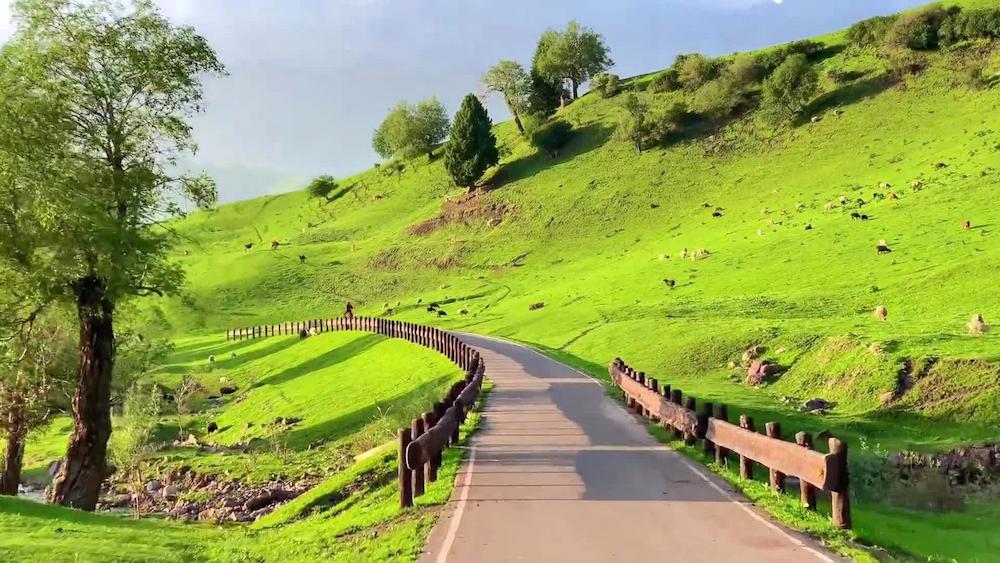
The place people mean when they say “apricot valley” is Tuergen Wild Apricot Forest (吐尔根野杏沟), in Xinyuan County, Ili Kazakh Autonomous Prefecture. It is not a planted orchard. These are wild apricot trees, remnants of Tianshan broadleaf forest, scattered across rolling grassland at roughly 1,200 to 1,800 metres. When they bloom the effect is strange and a little untidy: pink and white clumps thrown across green slopes, sheep grazing between them, no rows, no symmetry. That messiness is the whole appeal.
Quick Reference
| Item | Detail |
|---|---|
| Location | Tuergen Township, Xinyuan County, Ili Prefecture, Xinjiang |
| Entrance fee | Around ¥60–75 in recent seasons, plus a compulsory shuttle bus of roughly ¥30–40 return |
| Best time | Roughly 5–20 April; peak usually lands somewhere in the 8–15 April window |
| Elevation | Approximately 1,200 m at the gate, 1,800 m on the upper ridges |
| Time needed | Half a day minimum; a full day if you walk the upper slopes |
| Distance from Yining | Around 180 km, about 3 hours by car |
| Role in a trip | The one spring-only sight in Ili; pairs with Yining old town and Nalati |
Treat the fee figures as a planning range, not a quote. Xinjiang scenic areas adjust pricing between seasons, and in some years the gate price during peak bloom week has been higher than in the shoulder days.
Ili Apricot Flower Valley Guide: What the Slopes Are Actually Like
You park at a lower lot and queue for a shuttle. In peak week that queue is real. On 11 April 2023 I waited fifty minutes at 10:20 in the morning, standing in a line of maybe three hundred people, most of them domestic tourists off tour buses from Urumqi. The shuttle climbs about fifteen minutes up a rough road and drops you at a viewing area with wooden walkways.
Here is the part that matters. Most visitors stay on those walkways, take photographs of the same three angles, and leave within ninety minutes. If you walk uphill for twenty minutes past the last railing, the crowd density drops by something like ninety percent. On my 2023 visit I climbed to a saddle above the main viewpoint and sat for an hour with two Kazakh boys on a motorbike and nobody else. The blossom looked the same. The experience did not.
The light is the other thing. Between roughly 11:00 and 16:00 the valley is flat and washed out, and the photographs come back disappointing. Early morning, before the first shuttle crowd, gives you mist in the gullies and side-lit slopes. I have twice paid a driver extra to get me to the gate before it opened. Both times it was worth the money.
One honest caution. Bloom is not uniform. Different slopes open days apart depending on aspect and altitude, so even in a good week you may find the south-facing hillside already dropping petals while the north side is still tight buds. Nobody gets a fully pink valley. Anyone who tells you otherwise is showing you a composite.
How to Get There
From Yining (Ghulja). This is the standard base. Yining to Tuergen is roughly 180 km on G218 and county roads, about three hours. A chartered car for the day runs somewhere around ¥600–900 depending on season and how hard you bargain, split between passengers. During peak bloom week, day tours from Yining are sold everywhere and cost roughly ¥200–300 per person including transport, though most of those tours give you far too little time on the ground.
From Urumqi. Fly to Yining Airport (YIN) in about 1 hour, or take the high-speed-adjacent rail service to Yining in roughly 10 to 11 hours overnight. Driving the whole way is around 700 km. I would not drive Urumqi to Tuergen in one push unless you enjoy long days behind the wheel. If you want a broader route plan, my Xinjiang spring itinerary covers how the apricot bloom fits with the rest of April.
From Xinyuan County town. Around 90 km, roughly 1.5 hours. Staying in Xinyuan instead of Yining saves you three hours of morning driving and is the single best logistics decision available. See the Xinyuan travel guide on this site for what the town itself offers.
Public transport. Possible but awkward. Buses run Yining to Xinyuan regularly, then you need a local car or shared taxi to Tuergen Township and onward to the gate. Budget most of a day each way. In bloom week the shared taxis mark up heavily.
Note also that the Duku Highway is closed in April. Do not plan a loop that depends on it.
Best Time to Visit
The short answer on the best time to visit Ili Apricot Flower Valley is the second week of April, and everything below explains why that answer comes with caveats.
Spring (April). The only reason to come. Bloom typically starts around 5 April on the lower slopes and finishes around 20 April up top, with peak most often between the 8th and the 15th. In a warm year it runs early. In 2021 the peak was already fading by 10 April; in 2022 it held until nearly the 18th. Check Chinese social media for live reports in the ten days before you travel, since local users post daily bloom photos and they are far more reliable than any fixed calendar.
Summer (June to August). Green hills, no blossom, and almost no visitors at the apricot valley itself. The area is pleasant but there is no reason to prioritise it. Go to the grasslands instead.
Autumn (September to October). Yellow leaves on the apricot trees in early October can be quietly attractive, and Ili in general is excellent in autumn. Still, the site is not built around this season and facilities may run reduced hours.
Winter (November to March). Effectively closed. Snow, cold, no services.
My recommendation: target 10 to 14 April, build in two spare days, and accept that you are gambling. If you can only lock dates months ahead, choose the 12th as your centre point and treat anything you get as a bonus. And if the bloom fails, Yining old town and the surrounding valleys still make the trip worthwhile.
Where to Stay
Budget. Guesthouses in Tuergen Township and nearby villages, roughly ¥120–250 per night in bloom week. Basic rooms, sometimes shared bathrooms, often run by Kazakh families. Book early. In peak week these fill months ahead and prices climb hard.
Mid-range. Business hotels in Xinyuan County town, around ¥250–450. Clean, heated, hot water reliable, and you are only 90 minutes from the gate. This is what I use.
Upper. Yining has proper four-star hotels from roughly ¥450–800, with the better ones near the city centre and Liuxing Street. Comfortable, but you pay in driving time. Details on the city are in the Yining travel guide.
One practical note: during peak week, some guesthouses require multi-night minimums and prepayment. Confirm cancellation terms in writing before you send money.
Food
Ili food is Kazakh and Uyghur with a heavy Russian-influenced bakery tradition in Yining. Rough prices from recent visits:
- Nan bread from a street oven, ¥3–8 depending on size and whether it has sesame and onion.
- Laghman (拌面), hand-pulled noodles with stir-fried mutton and vegetables, ¥25–40. Refills of plain noodles are often free.
- Polo (抓饭), rice with carrot, onion and lamb, ¥20–35 a plate.
- Kawapu (烤肉), mutton skewers, ¥5–8 each. Order six per person and you will still want more.
- Naren (纳仁), Kazakh boiled meat over flat noodles, ¥60–120 for a shared plate. This is the dish to try in Tuergen itself.
- Kvass and horse milk, ¥5–15. The fermented mare’s milk is an acquired taste and I am still not sure I have acquired it.
Inside the scenic area, food is limited to instant noodles, sausages and overpriced snacks. Bring lunch. I usually buy nan and dried fruit in Xinyuan the night before.
Practical Tips
- Arrive at the gate before 09:00. The shuttle queue in peak week roughly triples between 09:30 and 11:00. Every extra hour you sleep costs you forty minutes of standing.
- Walk past the boardwalks. Twenty minutes uphill gets you solitude. The valley rewards effort more than equipment.
- Carry your passport. Xinjiang has routine ID checkpoints on regional roads. Foreign visitors will be registered at hotels and sometimes at checkpoints; keep the physical passport on you, not in a bag in the boot.
- Dress for 10°C swings. April mornings can sit near freezing at 1,800 m while afternoons hit 20°C. Layers, windproof shell, proper shoes for wet grass.
- Cash is still useful. Most vendors take WeChat Pay and Alipay, but a few village stalls and shuttle add-ons prefer cash. Keep ¥300 in small notes.
- Check the bloom before you commit. Search recent posts on Chinese platforms for 吐尔根杏花 in the week before travel. Local guesthouse owners will also answer honestly if you ask by message.
- Book the car, not the tour. A private driver lets you leave at 07:00 and stay past 18:00. Group tours typically give you two hours in the middle of the day, which is the worst light and the worst crowds.
- Respect the herders. Livestock graze through the valley. Close gates, do not walk into fenced pasture, and ask before photographing people.
- Drones are restricted. Rules vary by year and enforcement is inconsistent. Assume no, and ask staff at the gate before you fly anything.
Sample Itinerary
This is the two-day version I now use, based out of Xinyuan.
Day 1
- 08:00 Depart Yining by private car
- 11:00 Arrive Xinyuan County town, check in, quick laghman lunch
- 13:30 Drive to Tuergen Township, roughly 1.5 hours
- 15:30 Afternoon visit to the valley, focus on upper slopes as the light softens
- 18:30 Return to Xinyuan, dinner of polo and skewers
Day 2
- 06:30 Leave Xinyuan in the dark
- 08:15 At the gate before opening, first shuttle up
- 08:45 Morning mist and side light on the ridges, two to three hours of walking
- 12:00 Descend, buy nan and dried apricots in the township
- 13:30 Drive on toward Nalati, roughly 2 hours, or return to Yining
Slot this into a wider Xinjiang itinerary and the apricot valley works best as a two-night detour rather than a standalone trip, which is the main scheduling point of this Ili Apricot Flower Valley Guide. Any Xinjiang travel guide that tells you to fly in for a single afternoon is selling you a photograph, not a journey.
If you have a third day, continue east to the grasslands. The transition from apricot bloom to alpine pasture in the same week is one of the better sequences in Ili, and the Nalati Grassland travel guide explains what is open that early in the season.
FAQ
How long does the bloom last? On any individual slope, roughly seven to ten days. Across the whole valley, allowing for aspect and altitude differences, you get a usable window of about two weeks. The truly good days number maybe five.
Is it worth going if I miss peak bloom? Partially. Three or four days after peak you still get plenty of flowers with petal fall adding texture. Ten days after, as I learned in 2019, you get green hills and regret. Before peak, tight buds photograph poorly but the crowds are much thinner.
Can foreign tourists visit independently? Yes. Ili prefecture including Xinyuan and Tuergen is open to independent foreign travel. You will pass ID checks, hotels will register your passport, and not every small guesthouse is licensed to accept foreign guests, so confirm before booking. Rules do get adjusted, so verify current conditions close to your travel dates.
How does this compare to other apricot valleys? Tuergen is the largest and most famous. Xinyuan County has smaller wild apricot areas with fewer visitors, and there are apricot blossoms around Yining too. If crowds bother you more than scale, ask a local driver about the alternatives; several are free to enter.
Do I need a guide? No. You need a driver. The site itself requires no interpretation, but the roads and timing do, and a local driver who knows the bloom will earn back their fee in avoided mistakes. Browse more Xinjiang attractions if you are assembling a wider route.
Is it crowded on weekdays? Less so, noticeably. If your peak week includes a weekend, use the weekend for Yining city and the weekdays for the valley.
Disclaimer
Prices, opening hours, shuttle arrangements, drone rules and entry conditions in Xinjiang change without much notice, and bloom dates vary by several days from year to year. Every figure here comes from my own visits between 2019 and 2025 and should be treated as a planning estimate, not a guarantee. Verify current ticket prices with the scenic area, confirm access and registration requirements with your accommodation, and check official sources before you finalise bookings. If something in this guide has gone out of date, trust the local information over this page.