

Published: 2026-07-27 | Author: Karl Huang
My first real taste of Xinjiang in May came in 2019, when I pointed a rented Toyota Land Cruiser west out of Urumqi on the morning of May 8. I had nine days and a budget of about 4,200 RMB for fuel, tolls, and rooms. What I found was a region caught between two seasons at once. The north was still shaking off winter. The south had already leaned into summer. That split is the whole reason May can be a smart window if you build your route around it instead of against it.
Quick Reference
| Place | Location | Entry fee (RMB) | Best May window | Elevation |
|---|---|---|---|---|
| Sayram Lake | Bortala, NW Xinjiang | 70 entry + 75 shuttle | May 10 to Jun 10 (thaw) | 2,073 m |
| Nalati Grassland | Xinyuan, Ili Valley | 95 + 40 shuttle | May 15 to Jun 30 (greening) | 1,800 to 2,100 m |
| Kashgar Old City | Kashgar, SW Xinjiang | Free (Id Kah Mosque 30) | May is warm and dry | 1,289 m |
| Turpan Grape Valley | Turpan, east | 60 | Late May, before peak heat | minus 154 m |
| Duku Highway | Tianshan crossing | Free (seasonal) | Opens late May or Jun 1 | 3,400 m peak |
What Xinjiang in May Actually Feels Like
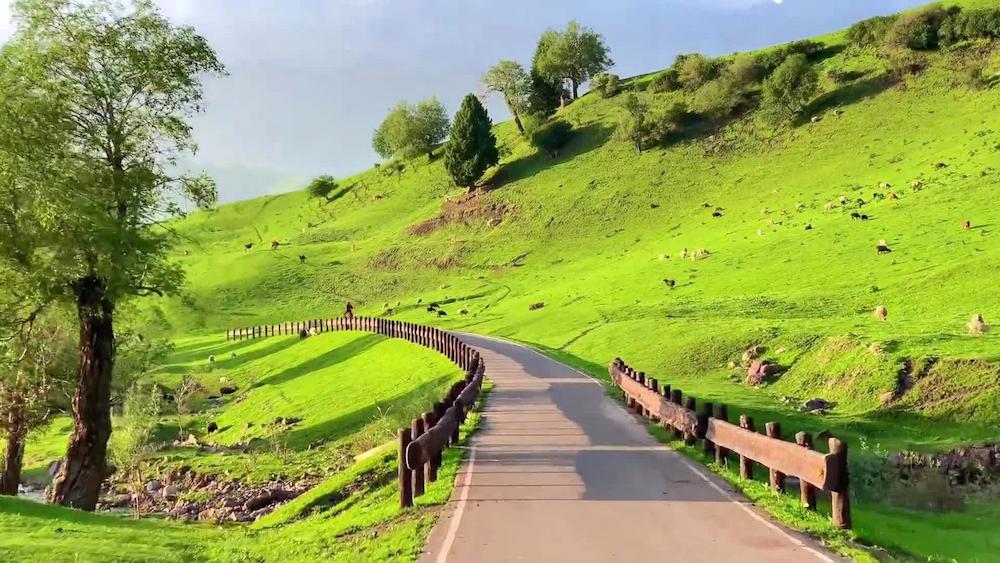
I spent the first three nights of that 2019 trip in Yining, the hub of the Ili Valley. On May 9 the temperature at 8 a.m. was about 6°C, and by midday it touched 21°C. The apricot trees along the country roads were just past full bloom, and the grasslands above Nalati were a thin, bright green that you only get for roughly three weeks a year. I paid 140 RMB for a clean double at a local inn, ate lagman noodles for 22 RMB, and watched a hailstorm roll through at 4 p.m. then clear by dinner. That is May in the north: changeable, quiet, and cheap. For me, Xinjiang in May in the Ili Valley is the version of the region I tell friends to see first.
Four days later I was in Kashgar, where the same calendar date meant 28°C and zero rain. The Old City was busy with residents, not tour groups. A plate of mutton skewers and a round of naan at the night market ran me under 40 RMB. In Xinjiang in May the north and the south feel like different countries separated only by a week of calendar, and that contrast is the thing most first-time visitors underestimate.
How to Get There
Most international travelers fly into Urumqi Diwopu International Airport (URC). From there the rail network does the heavy lifting. The overnight train from Urumqi to Kashgar is the classic move: a hard sleeper costs roughly 320 RMB and a soft sleeper about 500 RMB, and you save a hotel night while crossing 1,450 km. I have ridden it four times and the views across the edge of the Taklamakan at dawn are worth the stiff bed. For the Ili Valley, the Urumqi to Yining train takes about 11 hours, and a lower bunk makes the night easier. Details and current schedules are in our Xinjiang by train travel guide.
If you want to cover ground fast, domestic flights link Urumqi with Kashgar, Yining, and Turpan several times a day, usually priced 600 to 900 RMB one way when booked two weeks out. Renting a car with a driver runs about 800 to 1,200 RMB per day including fuel, and that is the only practical way to use the Duku Highway once it opens. Note that the Duku Highway, the northern section especially, is closed through winter and typically reopens around June 1, sometimes a week or two earlier if the snow melts early. In mid May plan on it being shut and route around via the G30 or G3012 corridors.
Best Time to Visit
May sits in a sweet spot that most people miss because they only think about July and August. Here is the season by season picture so you can see where May lands.
Winter, from December through February, is harsh and many passes close. Spring, which in Xinjiang means roughly April through early June, is when the north wakes up. May is the back half of that window: warm enough to be comfortable, cold enough at night to need a real jacket, and far ahead of the summer crowds that jam the grasslands from July onward.
Summer, from June through August, is peak season. The weather is reliable but hotel prices in Kanas and Nalati can triple, and the popular boardwalks get crowded by 10 a.m. Autumn, September through October, is the famous Kanas foliage period and arguably the most beautiful month, but it is also the second busiest. Xinjiang in May also skips the September hotel spike while still giving you green valleys and snow-line peaks. For photography, the Ili apricot and wildflower blooms plus the last snow on the peaks give you layered, contrast rich scenes without the summer haze. Our Xinjiang photography guide walks through the exact spots and light windows.
My recommendation is simple. If your priority is low prices, open roads, and green valleys, travel in the middle two weeks of May. If you must have the Duku Highway open or want guaranteed warm weather, wait until late June. Any straight talking Xinjiang travel guide will confirm that May is the shoulder season: you trade a little weather certainty for a lot of empty space. Either way, the best time to visit xinjiang in may comes down to whether you prefer a region in transition or a region at full tilt.
Where to Stay
Budget travelers will find clean, functional rooms easily. Chain inns like 7 Days and Home Inn run 120 to 180 RMB a night in Urumqi, Kashgar, and Yining, and I have slept well in all three. In smaller towns such as Xinyuan or Bole expect 100 to 150 RMB for a decent guesthouse.
Mid range picks sit around 300 to 500 RMB. In Urumqi the Vienna International and Hampton by Hilton are dependable. In Kashgar the versions of these near the Old City put you within walking distance of the Sunday livestock market. Book these a week ahead in May and you will usually get the listed rate with no surge.
Upper end travelers can look at 700 to 1,200 RMB per night. The Luxemon in Urumqi and the boutique courtyard hotels inside restored Kashgar Old City houses are the standouts. I stayed in a renovated courtyard near Id Kah Mosque for 880 RMB in May 2023 and it was the most memorable room of that trip. A solid Xinjiang itinerary books the upper tier only on the nights you actually want to relax, not every night.
Food
Eating your way across Xinjiang in May costs less than in peak summer and the produce is fresher. Start with big plate chicken (dapanji): a full plate for two runs 68 to 98 RMB and comes with hand pulled noodles underneath. Lagman, the stir fried noodle dish, is 18 to 25 RMB and fills you for a day of driving. Mutton skewers are 3 to 5 RMB each. Order ten and a round of naan, which costs 3 to 5 RMB, and you have dinner for two under 80 RMB.
In Kashgar the morning market samsa, baked meat pies, cost 4 to 6 RMB and disappear by 10 a.m., so go early. Pilaf (zhua fan) with carrots and lamb is 25 to 35 RMB at a hole in the wall and better than the 60 RMB version at the hotel buffet. For a structured crawl through the regional dishes, our Xinjiang food tour guide maps the cities and the stalls worth the detour. One caution: in May the high pastures are still cold, so the dairy heavy Kazakh and Kyrgyz dishes, like kurt and fresh cheese, are at their best up north, not down south.
Practical Tips
- Pack for two climates. A light down jacket, a wind shell, and short sleeves all earn their place in the same suitcase in May.
- Carry cash in smaller towns. Card and WeChat Pay work in the cities, but a roadside noodle stop near the mountains may only take cash.
- Check the Duku Highway status before you build a loop around it. If it is still closed, the G30 corridor gets you most places with an extra half day of driving.
- Bring altitude awareness for the Tianshan crossings. Even the passes you drive top 3,000 m, and a slow first day helps.
- Book the Urumqi to Kashgar sleeper train early. The soft sleeper sells out on weekends even in shoulder season.
- Respect the prayer schedule at mosques. Id Kah and the smaller village mosques are active, and visiting outside prayer times keeps everyone comfortable.
For a full packing breakdown by region and season, see our Xinjiang packing list guide. It covers the exact layers, the power adapters, and the small items, like lip balm and a neck gaiter, that matter more in dry May air than people expect.
Sample Itinerary
This 10 day Xinjiang in May loop balances both halves of the region, starting green in the north and finishing warm in the south.
Day 1: Fly into Urumqi, rest, walk the International Grand Bazaar in the evening.
Day 2: Morning train or drive to Yining; afternoon stroll through the apricot orchards.
Day 3: Nalati Grassland day trip, green valleys and a Kazakh yurt lunch.
Day 4: Drive the Ili loop to Sayram Lake, overnight in Bole.
Day 5: Fly or train to Kashgar; evening at the Old City gates.
Day 6: Kashgar Old City and the Sunday market, time it for the weekend.
Day 7: Day trip toward Karakul Lake if the road is clear; otherwise the city museums.
Day 8: Fly to Turpan; explore the Grape Valley and the Karez system.
Day 9: Turpan to Urumqi, stop at Tianchi if weather allows.
Day 10: Buffer day or flight out.
FAQ
Is May too cold for Xinjiang?
Not for most of it. The south and the Turpan basin are warm. The far north, Kanas and Altay, stays cold and some facilities there do not open until June, so skip the extreme north in May and save it for September.
Will the Duku Highway be open in May?
Usually not until around June 1. Plan your route without it and treat an early opening as a bonus, not a plan.
How busy is it compared with summer?
Much quieter. I have walked the Nalati boardwalks in mid May with maybe a tenth of the July crowds, and hotel rates reflect that.
Do I need a border permit in May?
Only for restricted areas such as parts of the Karakul Lake road and the Khunjerab crossing. The standard tourist circuit does not. Check the current list with official sources before you go.
What should I photograph in May?
The Ili wildflowers, the snow line on the Tianshan, and the empty Old City lanes at blue hour. The contrast is the selling point.
Disclaimer
Prices, permits, train schedules, and the Duku Highway opening date change from year to year and were accurate to the best of the author’s knowledge at the time of writing. Always confirm entry fees, road status, and visa or permit requirements with official sources, the Xinjiang tourism bureau, China Railway, and your embassy, before you travel. This article is practical guidance based on first hand trips, not a guaranteed quote.