

Published: 2026-07-31 | Author: Karl Huang
The first time I drove out to the Flaming Mountains, in August 2019, I made a mistake that I now warn every client about. I arrived at 2:10 in the afternoon. The car thermometer said 46°C. I stepped out of the air conditioning, walked maybe forty metres across the parking lot, and felt the soles of my shoes soften on the asphalt. This Flaming Mountains Movie Set Guide exists because I want you to skip that particular lesson and still get the photographs you came for.
There is also an expectation problem worth clearing up in the first minute. Search results promise a “movie set,” which makes people picture a standing backlot with wooden gates and costume racks, the sort of thing you find outside Hengdian. That is not what is here. What you actually get is a themed sculpture corridor and outdoor statue park built inside the Flaming Mountains Scenic Area, dedicated to Journey to the West, the novel that made this ridge famous across the Chinese-speaking world. The 1986 CCTV television adaptation cemented the association, and film crews have been shooting against these red sandstone folds ever since. Knowing that in advance changes a disappointing stop into a good one.
Quick Reference
| Item | Detail |
|---|---|
| Location | Northern rim of the Turpan Basin, roughly 40 km east of Turpan city centre, on the old G312 road toward Shanshan |
| Entrance fee | Around 40 RMB per adult in recent seasons; student and senior discounts commonly applied. Verify before you go. |
| Opening hours | Roughly 08:30 to 20:30 in summer, shorter in winter (Xinjiang runs on Beijing time but daylight is about two hours later) |
| Best time | Late April to early June, and mid-September to late October |
| Elevation and role | Base sits near sea level inside a below-sea-level basin; the ridge peaks around 831 m. Its role is scenic and cultural rather than a working studio. |
| Time needed | 60 to 90 minutes, longer if you photograph the ridge from the roadside |
Flaming Mountains Movie Set Guide: What the Site Is Actually Like
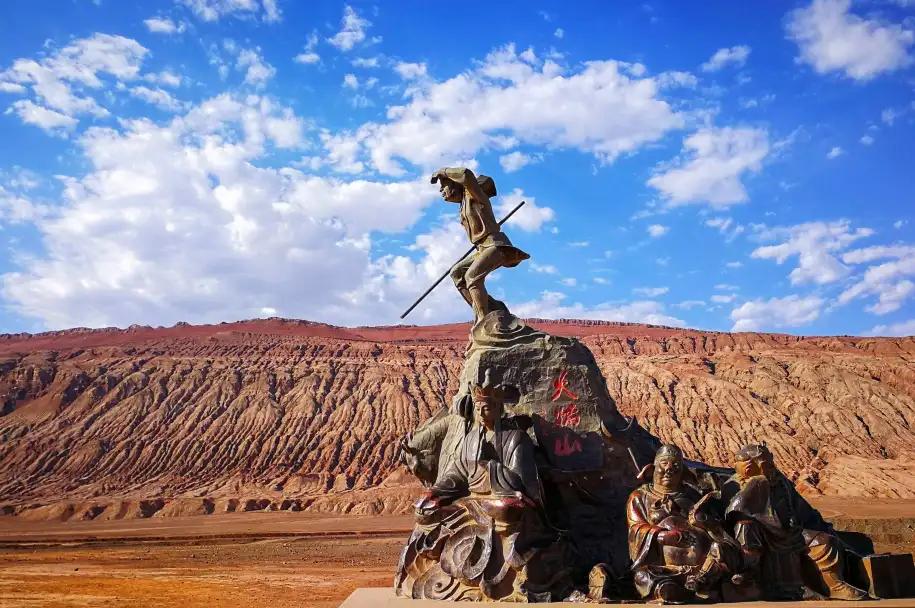
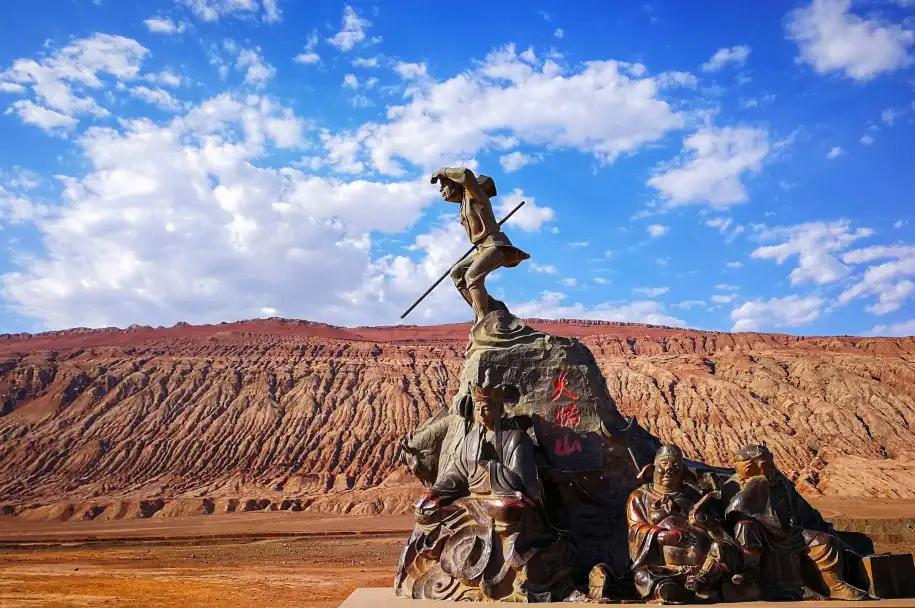
You approach along a straight road with the ridge running parallel on your left. The rock is a deep rust colour, cut by hundreds of vertical gullies that erosion has scored into the face. In strong midday sun those gullies flatten out and the whole range looks like a brown wall. In low light they fill with shadow and the surface appears to ripple. That single fact governs everything about when you should show up.
The main entrance leads down into an underground corridor. This is the smart part of the design. Because the gallery is cut into the ground, it stays perhaps ten degrees cooler than the surface, and it houses the exhibition: relief carvings, painted panels retelling the pilgrimage story, and display cases covering Turpan’s Silk Road history. At the centre stands the site’s signature object, a tall golden thermometer shaped like Sun Wukong’s staff. It reads out the ground surface temperature. On my August visit the display showed a surface reading well above 70°C while the air temperature was in the mid forties. Tour groups queue to photograph it, and yes, I queued too.
Above ground you walk out to the statue cluster. Tang Sanzang on his horse, Sun Wukong, Zhu Bajie, Sha Wujing, and on a separate platform, Princess Iron Fan with her palm-leaf fan and the Bull Demon King. The figures are large, cast in bronze-toned metal, and they photograph well against the red slope behind them if you keep the sun off your lens. There are camel rides in the open area, priced at roughly 30 to 50 RMB for a short circuit, and a few costume-rental stalls where you can put on a monkey-king outfit for a photo. It is unashamedly commercial. It is also genuinely fun with children, and the site is one of the easier stops to fold into a wider Xinjiang attractions circuit around Turpan.
What surprised me most was how quiet the outer edges are. Walk two hundred metres away from the statue platform toward the boundary fence and the crowd noise drops off completely. You get the ridge, the heat shimmer, and nothing else. That is the image most people remember afterwards, not the bronze monkey.
How to Get There
From Urumqi, the fast option is the high-speed train to Turpan North Station, which takes a little over an hour with several departures daily. From that station you still need road transport for the final leg, so either pre-book a driver or use a ride-hailing app in Turpan city. Expect 40 to 60 minutes and roughly 100 to 150 RMB one way for a private car, more if the driver waits.
Driving yourself from Urumqi is straightforward on the G30 expressway, about 190 km and two and a half hours to Turpan, then east on the old road. Rental cars are widely available at Urumqi Diwopu Airport. Watch your fuel: filling stations in Xinjiang usually require the driver to present ID and passengers to step out of the vehicle during refuelling, which adds time.
Most visitors do not come here alone. The practical approach behind this Flaming Mountains Movie Set Guide is to treat the site as one stop on a single-day eastern loop out of Turpan, chained with the Bezeklik Caves guide route through Mutou Valley, which sits directly behind this same ridge, and then the ancient walled city at Gaochang Ruins. A full-day car charter covering that loop generally runs 500 to 800 RMB depending on vehicle and season. Split between three or four people it is the best value in the area.
From Kashgar or Yining, there is no sensible direct route. Fly or take the train to Urumqi first, then continue as above.
Best Time to Visit
Turpan is the hottest inhabited basin in China, and that single condition decides your calendar.
Spring, April to early June. My preferred window. Daytime highs climb from the low twenties into the mid thirties, the light is clean, and the tour-bus volume is still moderate. Early May is close to ideal.
Summer, late June to August. Air temperatures routinely hit 43 to 47°C and the ground is far hotter. Visits become a series of short dashes between shaded points. Some travellers actively want this, because standing in genuine extreme heat is part of the story they came for. If that is you, restrict yourself to before 10:00 or after 19:00, and carry more water than feels reasonable.
Autumn, mid-September to late October. The strongest all-round choice. Comfortable temperatures, harvest season in the surrounding vineyards, and the low autumn sun does flattering things to the ridge gullies. Book accommodation earlier during the October national holiday.
Winter, November to March. Cold, sometimes below freezing, with thin visitor numbers. Some facilities reduce hours. The rock still reads red against a pale sky and you will have the place nearly to yourself, but the camel rides and stalls may not be operating.
If someone asks me for one answer on the best time to visit Flaming Mountains movie set, I say the first three weeks of October, arriving at either 09:00 or 17:30. That is when the light and the temperature stop fighting each other.
Where to Stay
Nobody stays at the mountains themselves. Base yourself in Turpan city, 40 km west, where the whole range of options sits within a fifteen-minute drive of each other.
Budget, roughly 120 to 200 RMB per night. Small guesthouses and family-run inns near the Turpan bazaar area. Clean, air-conditioned, and often built around a grape-trellis courtyard that drops the temperature noticeably after dark. Confirm in advance that the property accepts foreign passports, because not all budget properties in Xinjiang are registered to do so.
Mid-range, roughly 300 to 500 RMB per night. Business hotels near the city centre and a handful of vineyard-adjacent properties toward Grape Valley. This tier is where the value sits. You get reliable air conditioning, breakfast, and staff used to arranging cars.
Upper, roughly 600 to 1,000 RMB per night. A limited selection of four-star and resort-style hotels with pools. Turpan is not a luxury destination and the top tier here would be mid-range in Urumqi, so adjust expectations rather than budget.
One practical note that belongs in any honest Xinjiang travel guide: air conditioning capacity matters more than star rating in July and August. Ask specifically whether the unit is in the bedroom, not just the living area.
Food
Eat in Turpan city or at the small restaurant clusters near Grape Valley rather than at the scenic-area stalls, which are priced for captive customers.
- Hand-pulled laghman noodles (拌面), around 25 to 35 RMB. The default Xinjiang meal. Ask for the free noodle refill, which most local places still offer.
- Lamb kebabs (烤肉串), around 5 to 10 RMB per skewer. Order five to start. Turpan versions tend to be cumin-heavy.
- Nan bread, 3 to 8 RMB depending on size and whether it is the sesame version. Buy it hot in the morning from a tandoor stall.
- Dapanji, big plate chicken, around 90 to 140 RMB for a portion that feeds three. Belt noodles go in at the end to soak up the sauce.
- Turpan grapes and raisins, seasonal and cheap. Seedless white raisins run roughly 30 to 60 RMB per kilogram at the bazaar. Prices at roadside stops near the tourist sites are considerably higher.
- Cold noodles (凉皮), around 12 to 18 RMB. The thing you will actually want after an hour in the heat.
Practical Tips
- Carry at least two litres of water per person for a short visit in summer. There are vendors on site, but they charge several times the city price and running out between them is genuinely dangerous.
- Wear closed shoes with a thick sole. Thin-soled sandals transmit ground heat fast enough to be uncomfortable within minutes.
- Do not leave a phone, camera, or bottled water sitting in a parked car. Devices overheat and shut down. I have seen a phone refuse to power on for twenty minutes after a short dashboard exposure.
- Bring a wide-brimmed hat and a light long-sleeved shirt rather than relying on sunscreen alone. Covering skin outperforms reapplying lotion here.
- Time your arrival for the first hour after opening or the last two hours before closing. Midday gives you flat light and maximum heat at once.
- Bring cash for camel rides and small stalls, though mobile payment is accepted almost everywhere. Foreign visitors should set up a linked payment app before arriving in Xinjiang.
- Keep your passport with you. Checkpoints on regional roads are routine, and hotel registration requires the original document.
- Combine the visit with at least two nearby sites. On its own the stop is short, and the drive out does not justify a single 60-minute stand-alone visit.
- If you are photographing the ridge from the roadside outside the paid area, pull fully off the carriageway. The old road carries fast truck traffic.
- Travellers with heart conditions, and anyone travelling with small children or elderly parents, should avoid the site entirely between 12:00 and 17:00 in July and August.
Sample Itinerary
A one-day eastern loop from Turpan city, built for autumn conditions.
- 08:00 Breakfast at the hotel or a nan stall. Load water into a cooler bag.
- 08:45 Depart Turpan city by car heading east.
- 09:20 Arrive at the Flaming Mountains Scenic Area. Underground gallery first while the outdoor light is still low, then the statue park and the ridge viewpoint.
- 10:45 Continue north into Mutou Valley for the Bezeklik Thousand Buddha Caves, about 25 minutes away.
- 12:15 Drive to Tuyoq Village for lunch in the old settlement and a walk through the mud-brick lanes.
- 14:30 Gaochang Ruins. Take the electric cart across the site rather than walking the full circuit in open sun.
- 16:30 Grape Valley for shade, fruit, and cold drinks.
- 18:00 Return to Turpan city.
- 19:30 Dinner, kebabs and cold noodles, then an evening walk once the streets cool down.
If you only have half a day, cut Gaochang and Grape Valley and keep the mountains plus Bezeklik.
FAQ
Is there a real film studio at the Flaming Mountains?
No. There is no standing production backlot open to visitors. The “movie set” reputation comes from the mountains being a recognised filming backdrop and from the Journey to the West themed sculpture park inside the scenic area. Arrive expecting a themed cultural site and you will enjoy it.
How long should I budget for the visit?
Sixty to ninety minutes covers the gallery, the statues, and photographs. Add fifteen minutes if you want a camel ride or costume photo.
Is it too hot to visit in summer?
It is uncomfortable rather than impossible, provided you go early or late and stay hydrated. Between noon and late afternoon in July and August, I advise clients to skip it or stay in the underground gallery.
Can I get there by public bus?
There is no convenient scheduled bus that drops you at the gate. Most independent travellers use a ride-hailing car from Turpan or join a day charter. This part of the Flaming Mountains Movie Set Guide is the one I would not improvise on.
Is the site suitable for wheelchair users?
Partly. The main paved areas and the gallery ramp are manageable, but some outdoor sections have steps and loose surfaces. Call ahead if this matters.
Do foreign passport holders need a special permit?
No permit is required for the scenic area itself. Standard identity checks apply on regional roads and at hotel check-in, so keep your passport accessible and allow extra time.
Disclaimer
Ticket prices, opening hours, charter rates, and meal costs in this Flaming Mountains Movie Set Guide reflect recent observation and are approximate. Figures in Xinjiang change season to season, and scenic areas occasionally adjust access rules, close sections for maintenance, or alter operating hours at short notice. Regional travel and identity-check procedures can also change. Verify current prices, hours, and entry requirements with the official scenic area management, your accommodation, or a licensed local operator before you travel. Nothing here should be treated as a guaranteed quotation.