

Published: 2026-07-31 | Author: Karl Huang
The first time I stood on Xianhuatai, the Flower Terrace platform on East Karajun, it was 7:40 in the morning and the thermometer on my backpack read 9°C. I had paid 120 RMB for the scenic area ticket and another 100 RMB for the shuttle bus the previous afternoon in Tekes County, and I had gambled on a mid-June date because a Kazakh driver named Bolat told me the yellow and purple layers peak “about ten days after the first hay cut.” He was right by roughly four days. This Karajun Flower Sea Guide is built from that trip and two later visits, including one in early August when I arrived to find mowed grass and almost no colour at all. Timing here is not a detail. It is the whole trip, and it is the single question this Karajun Flower Sea Guide exists to answer.
Karajun sits in Tekes County, Ili Kazakh Autonomous Prefecture, about 60 kilometres from the Bagua county town and roughly 220 kilometres from Yining. The grassland rolls over rounded ridges between 2,000 and 2,800 metres, and in bloom season the slopes carry bands of yellow buttercup, purple geranium and white umbellifer that shift as the light moves. It is a UNESCO-listed part of the Xinjiang Tianshan property, and on a June weekend you share the viewing decks with several hundred domestic travellers. Foreign visitors are rare enough that staff at the shuttle stop asked to photograph me.
Quick Reference
| Item | Detail |
|---|---|
| Location | Karajun Scenic Area, Tekes County, Ili Kazakh Autonomous Prefecture, Xinjiang |
| Entrance fee | Around 120 RMB per adult; shuttle bus roughly 100 RMB extra (compulsory inside the park) |
| Combined ticket | Karajun plus Kokesu Grand Canyon package often sold at 220 to 260 RMB |
| Best time | Mid-June to early July for peak bloom; late May to mid-July for green grass and scattered flowers |
| Elevation | 2,000 to 2,800 m across the plateau; Flower Terrace sits near 2,600 m |
| Time needed | One full day minimum; two days if you add Kokesu Grand Canyon |
| Opening hours | Typically 09:00 to 20:00 in summer, shorter in shoulder season |
| Nearest base | Tekes town (60 km, about 1 hour by car) |
Karajun Flower Sea Guide: What the Bloom Actually Looks Like
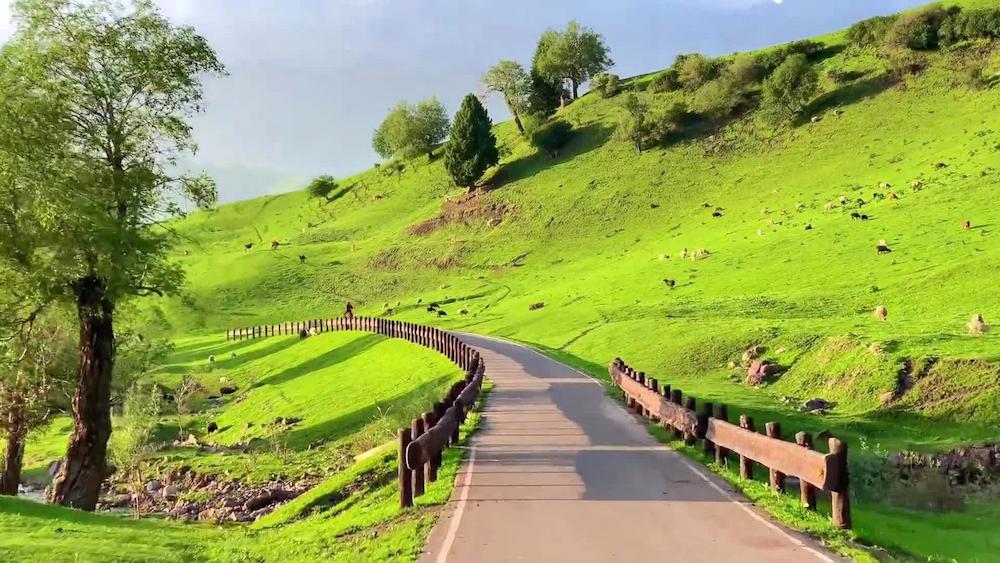
Let me set expectations, because online photos oversell this place badly. The flower sea is not a solid carpet of colour across every slope. It is patchy, and the density depends on altitude, aspect and whether local herders have already cut hay on that particular ridge. On my 16 June visit, the north-facing slopes below Flower Terrace were genuinely dense, maybe 60 percent flower cover, with yellow dominating and purple threading through the hollows. Three hundred metres away, on a south-facing slope that got more sun, the bloom was already past and the grass had gone seed-brown.
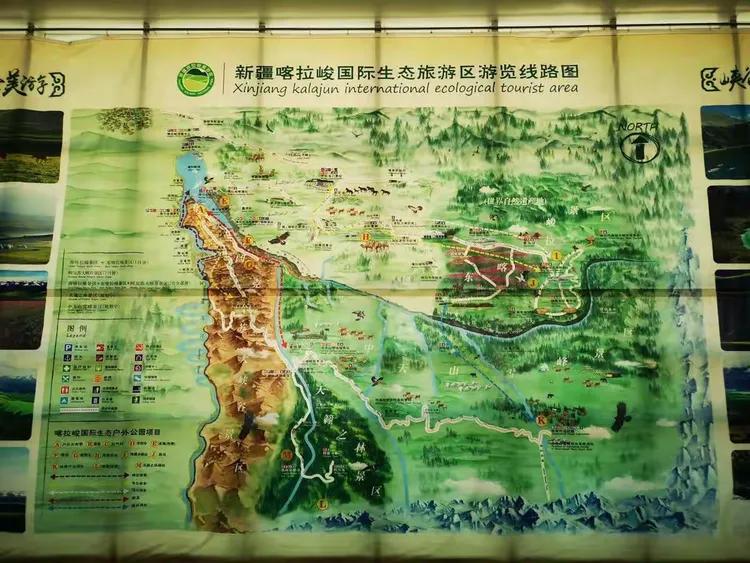
The shuttle inside the park runs a fixed loop with several stops. Falcon Terrace comes first, giving a wide view over the ridgelines. Flower Terrace is the one you came for, and it is where I spent nearly two hours. The walking path from the platform drops down a wooden boardwalk for maybe 800 metres, and almost nobody follows it to the end. That lower section gave me the best photographs of the trip, partly because the flowers were taller down there and partly because I finally had space to stand without someone’s selfie stick in frame. Wuhua Meadow, further along the loop, is flatter and more open, better for a picnic than for photos.
What surprised me most was the sound. At 8 in the morning, before the tour buses arrived, the loudest thing was wind through grass and a horse bell below the ridge. By 11:30 that was gone. I stayed overnight in Tekes and left at 06:50, which put me at the gate before the queue formed. For a wider look at the scenic area including the canyon side, my longer Karajun Grassland travel guide covers the sections I am skipping here.
One honest note. The famous “body grassland” ridge profile sits on the Kokesu Grand Canyon side, not at Flower Terrace. Several travellers I met bought a ticket expecting both in one afternoon and ran out of daylight. Budget separately for each.
How to Get There
From Urumqi, the fastest route is a flight to Yining Airport, about 1 hour 20 minutes, with fares I have seen between 500 and 900 RMB depending on how far ahead you book. The overnight train from Urumqi to Yining takes around 11 hours and a hard sleeper ran me about 240 RMB, which saves a hotel night and is genuinely comfortable if you get a lower bunk. Book sleepers early in July and August.
From Yining to Tekes, morning buses from the Yining bus station cost 60 to 70 RMB for a three-hour ride. A shared car through your guesthouse runs 100 to 150 RMB per seat and is faster. Self-driving takes about three and a half hours on good asphalt, easy apart from slow trucks near Gongliu.
From Tekes to the Karajun gate is 60 kilometres and roughly one hour. A one-way taxi runs 100 to 150 RMB, and most drivers will wait all day for 400 to 500 RMB total. If you are two or more people, hiring for the day is worth it, because there is no reliable public transport back in the evening and I watched a Chinese couple wait forty minutes for a ride they eventually paid double for.
From the Sayram Lake direction the drive is about four hours via Yining, or longer through Zhaosu. The Zhaosu variant has better scenery but adds ninety minutes, and roads need checking in early season.
Best Time to Visit: The Core of Any Karajun Flower Sea Guide
Spring, late April to late May. Snow leaves the lower slopes in April and the grass greens up through May. Flowers appear at lower altitudes near the end of May, but Flower Terrace is still thin. Nights drop near freezing, rooms are cheap, and grey weather is likely.
Summer, June to August. Mid-June to early July is the window. In my experience the reliable peak is roughly 10 June to 5 July, with the exact date shifting by a week either way depending on the winter. From mid-July the herders cut hay and the colour disappears fast. August is warm and green and pleasant, but if you came for flowers you will be disappointed, as I was on 3 August when I found neat rows of mown grass where the yellow had been.
Autumn, September to October. The grass turns gold, the light is excellent for photography, and crowds thin out sharply. Some facilities reduce hours and the shuttle may run a shortened loop. Bring a proper jacket. Mornings near 2,600 metres can sit around 2 to 5°C.
Winter, November to March. Most of the scenic area effectively closes and access roads can be snowbound. Not practical unless you are chasing winter photography with a local driver.
My recommendation: if you only remember one line from this Karajun Flower Sea Guide, make it this one. Aim for 15 to 28 June, arrive in Tekes the night before, and take the first shuttle. If you can only travel in July, go in the first week and accept that some ridges will already be cut. Travellers building a wider Ili loop often pair this with Nalati, and the seasonal pattern is similar there, as I explained in my notes on the best time to visit Nalati Grassland.
Where to Stay
Budget, 120 to 220 RMB per night. Tekes has many small guesthouses near the central ring roads of the Bagua layout. I paid 160 RMB in June for a clean double with private bathroom and reliable hot water. Rooms are basic and English is absent, so save your address in Chinese characters. Yurt stays on the grassland outside the park run 150 to 300 RMB per person including dinner and breakfast, and the experience is worth one night even though the bedding is thin and the toilet is a shared outhouse.
Mid-range, 300 to 480 RMB per night. A handful of newer business hotels in Tekes offer proper heating, lifts and breakfast. This is the sensible choice if you want an early start without discomfort. Book ahead for the June to August peak, because Tekes has limited inventory and prices climb steeply on weekends.
Upper, 600 to 1,100 RMB per night. Options are limited in Tekes. Travellers wanting more comfort usually base in Yining and make Karajun a long day trip, which costs you the early morning. My separate Tekes travel guide goes deeper on neighbourhoods and the eight-trigram street plan, which genuinely confuses first-time drivers.
Food
Eating in Tekes is one of the pleasures of this trip, and prices are lower than Urumqi. A plate of hand-pulled laghman noodles with lamb cost me 28 RMB. Big plate chicken runs 80 to 130 RMB and feeds two or three people with the belt noodles included. Lamb kebabs are 5 to 8 RMB each at street grills and 10 to 12 RMB in sit-down restaurants.
Kazakh milk tea, salty and made with butter, costs 10 to 20 RMB a pot and is what you want at 8 in the morning before a cold shuttle ride. Fresh nang bread from a tandoor oven is 3 to 6 RMB. Inside the scenic area, expect roughly double: I paid 45 RMB for an instant-noodle-and-sausage combination at Flower Terrace that would have been 15 RMB in town. Carry your own lunch. I brought nang, boiled eggs, dried apricots and two litres of water, and that covered a full day.
One note on dairy. Fresh horse milk and yoghurt drinks sell at roadside stalls for 10 to 15 RMB. They are excellent, but if your stomach is not used to unpasteurised dairy, start with a small cup.
Practical Tips
- Take the first shuttle of the day. The difference between 09:00 and 11:00 at Flower Terrace is the difference between a quiet ridge and a car park.
- Dress in layers. I wore a base layer, fleece and windproof shell at dawn and was down to a t-shirt by noon. Wind on the exposed platforms is constant.
- Bring real sun protection. At 2,600 metres the UV is harsh even at 18°C. Hat, sunglasses and SPF 50 are not optional, and I got burned on my first visit despite cloud cover.
- Carry cash as backup. Mobile payment works at official counters, but small herder stalls and some taxis prefer cash, and foreign cards do not work at most machines.
- Download offline maps before you leave Yining. Signal on the plateau is patchy and drops entirely in some valleys.
- Confirm ticket and shuttle prices on the day. They shift by season and packages change without notice.
- Respect grazing land. Fenced sections are working pasture, not photo props, and walking through cut hay makes you no friends.
- Allow buffer time for an onward flight from Yining. Afternoon traffic and shuttle queues can add an hour.
- Bring a power bank. Cold mornings drain phone batteries faster than you expect, and there are no charging points on the loop.
- If you plan to visit several sites across the region, check current entry requirements and opening dates through the Xinjiang attractions archive before locking in your route.
Sample Itinerary
Day 1
06:50 leave Tekes guesthouse with a pre-arranged driver. 07:50 arrive at the Karajun gate, buy or collect tickets. 08:10 board the first shuttle. 08:45 Falcon Terrace, 30 minutes for the wide ridge view. 09:30 arrive Flower Terrace. 09:30 to 11:30 walk the boardwalk down and back, photograph in soft light. 11:45 shuttle onward to Wuhua Meadow, eat the lunch you packed. 13:30 return loop, short second stop at Flower Terrace if the light improved. 15:00 exit and drive to Tekes. 16:30 walk the Bagua ring streets and climb the viewing tower. 19:00 dinner.
Day 2, optional add-on
08:30 depart for Kokesu Grand Canyon section, separate ticket. 10:00 to 14:00 canyon viewpoints and the reclining-ridge profile. 15:00 drive toward Zhaosu or back to Yining depending on your onward route.
FAQ
How much does Karajun cost in total for one day?
Budget roughly 400 to 600 RMB per person for a day trip from Tekes: 120 RMB entry, around 100 RMB shuttle, 150 to 250 RMB shared transport, plus food. Costs drop if you split a car between three or four people.
Is one day enough?
For the Flower Terrace side, yes, if you start early. Add a second day for Kokesu Grand Canyon. Compressing both into one afternoon is the most common mistake I see with this Karajun Flower Sea Guide route.
Do I need a permit as a foreign traveller?
No special permit is normally required for Tekes County or Karajun, but carry your passport and book only hotels licensed to register foreign guests. Several Tekes guesthouses are not.
What is the best time to visit Karajun Flower Sea?
Mid-June to early July, with 15 to 28 June the safest window. Late May is too early at Flower Terrace and mid-July onward risks mown ridges.
What if I arrive after the bloom?
The grassland is still worth the trip for the ridge landscape and the light, especially in September when everything turns gold. Set your expectations before you pay for the ticket rather than after.
Is altitude a problem at 2,600 metres?
For most people, no. You may feel short of breath climbing the boardwalk, but genuine altitude sickness is uncommon at this height. Take the stairs slowly, drink water, and skip alcohol the night before if you are sensitive.
Can I ride a horse there?
Yes. Kazakh herders offer short rides near the terraces, typically 100 to 200 RMB depending on distance and your bargaining. Agree the route and price before you mount, and take a photo of the saddle number if there is one.
Disclaimer
All prices, opening hours, ticket structures, shuttle arrangements and bloom dates in this article reflect my own visits and are provided for planning purposes only. Costs in Xinjiang change frequently, seasonal schedules are adjusted without public notice, and flower timing varies year to year with snowmelt and grazing. Entry rules for foreign travellers can also change. Verify current details with the Karajun scenic area management, your accommodation, or official Chinese tourism channels before you travel, and treat every figure here as an estimate rather than a guarantee.